



Managing online sales across Central Europe often means facing questions about taxes on products and services. For many e-commerce sellers, understanding what indirect tax really means and how it affects day-to-day operations can feel confusing. Since the European Union applies Value Added Tax at every stage of the supply chain, businesses must act as tax collectors while consumers ultimately bear the cost. This guide breaks down the essentials of indirect tax, helping you navigate VAT responsibilities with greater confidence.
Table of Contents
- What Is Indirect Tax and How It Works
- Major Indirect Tax Types: VAT, Excise, Duties
- EU VAT Rules for E-Commerce Transactions
- OSS and IOSS Schemes: Simplifying Compliance
- VAT Registration, Filing, and Payment Steps
- Common Compliance Issues and How to Avoid Them
Key Takeaways
| Point | Details |
| Understanding Indirect Tax | Indirect tax is levied on goods and services via intermediary parties, ultimately paid by end consumers, distinguishing it from direct taxes. |
| EU Tax System | The EU employs a structured taxation system for indirect taxes, primarily through VAT, which allows for revenue generation without directly taxing individual incomes. |
| E-commerce VAT Changes | Recent EU VAT guidelines for e-commerce mandate new compliance measures for online sellers, including the One Stop Shop (OSS) mechanism for simplified VAT reporting. |
| Compliance Strategies | Businesses must maintain meticulous records and utilise automated accounting software to ensure compliance with evolving VAT regulations and avoid penalties. |
What Is Indirect Tax and How It Works
Indirect tax represents a complex financial mechanism where taxation is levied indirectly on goods and services through intermediary parties. Unlike direct taxes paid straight from an individual’s income, indirect taxes are embedded within the price of products and services, ultimately passed on to the end consumer.
The European Union has developed a sophisticated taxation system for indirect taxes primarily through Value Added Tax (VAT). Here’s how indirect taxation fundamentally operates:
- Taxes are collected at each stage of production and distribution
- The tax burden is transferred through the commercial supply chain
- Final consumers ultimately bear the total tax expense
- Businesses act as tax collectors, remitting payments to governmental authorities
Under the EU framework, indirect taxation serves multiple crucial economic functions. Businesses registered for VAT can deduct input tax on their purchases from the VAT collected on their sales, creating a systematic mechanism for tax calculation and collection. This approach ensures transparency and allows governments to generate significant revenue without directly taxing individual incomes.
Key Characteristics of Indirect Taxation:
- Embedded in product/service pricing
- Transferable across production stages
- Ultimately paid by end consumers
- Calculated as a percentage of transaction value
Indirect taxes represent a sophisticated financial mechanism designed to distribute tax burdens across economic transactions without directly impacting individual taxpayers.
Pro tip: Always maintain meticulous records of your VAT transactions to ensure accurate tax reporting and compliance with European tax regulations.
Major Indirect Tax Types: VAT, Excise, Duties
Indirect taxes encompass several crucial financial mechanisms that governments use to generate revenue from economic activities. The European Union has developed a comprehensive system of taxation across multiple indirect tax categories designed to ensure fair economic participation and resource generation.
The primary types of indirect taxes include:
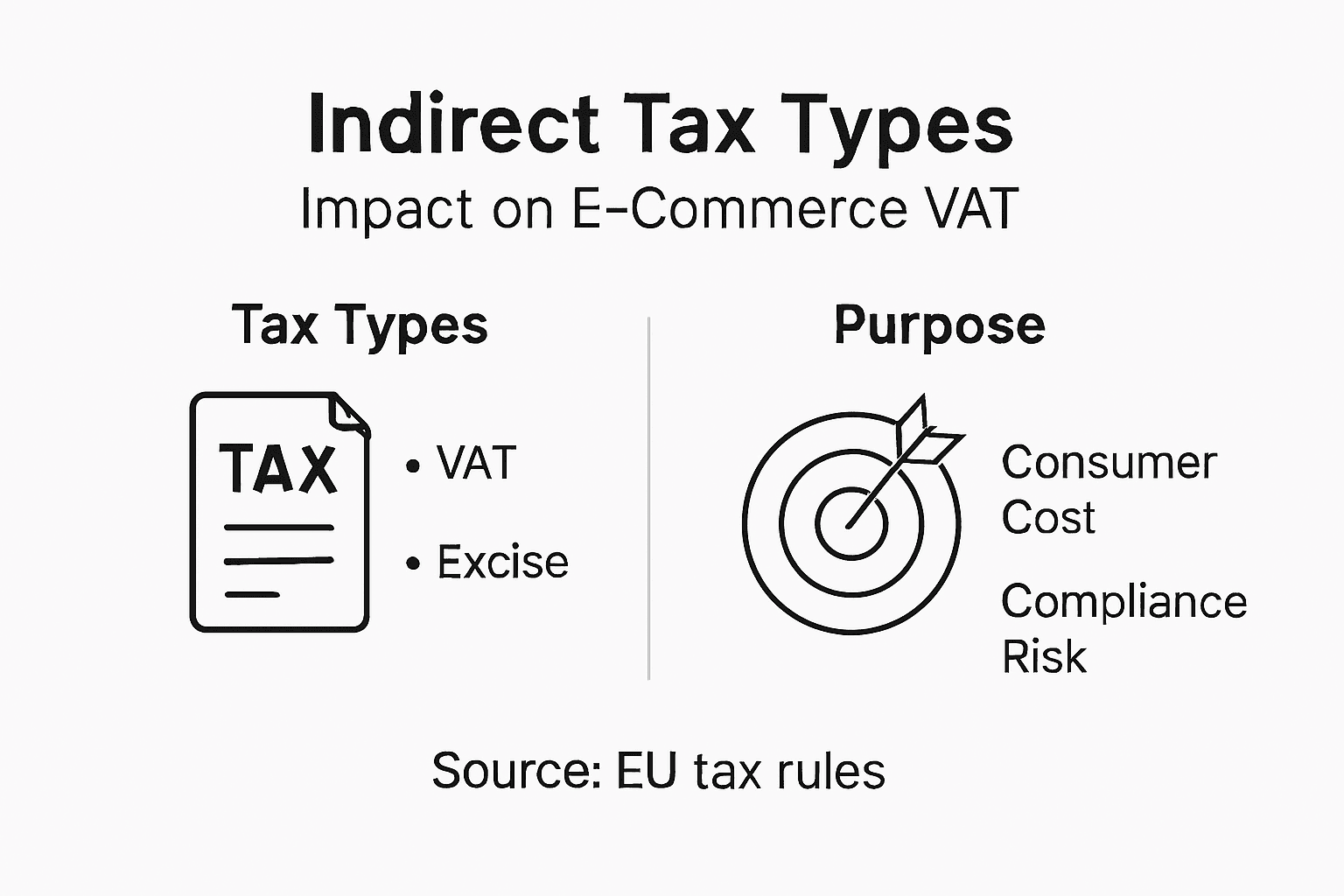
- Value Added Tax (VAT): A consumption tax applied at each stage of commercial transactions
- Excise Duties: Targeted taxes on specific goods considered harmful or luxurious
- Customs Duties: Taxes levied on imported and exported goods across international borders
Value Added Tax (VAT) represents the most widespread indirect tax mechanism in the European Union. This added value tax is calculated as a percentage of a product or service’s value and is collected incrementally throughout the production and distribution process. Unlike direct taxes, VAT is ultimately borne by the end consumer, making it a flexible revenue generation tool for governments.
Excise Duties target specific categories of goods that governments wish to regulate or discourage. These typically include:
- Alcohol products
- Tobacco merchandise
- Energy products
- Luxury goods
- Environmental impact products
Indirect taxes serve not just as revenue generators, but also as strategic economic policy instruments designed to influence consumer behaviour and market dynamics.
Customs duties represent another critical indirect tax category, applying to goods crossing international borders. These taxes help protect domestic industries, regulate international trade, and generate additional governmental revenue through import and export transactions.
Pro tip: Maintain detailed records of all indirect tax transactions to ensure accurate reporting and compliance with European tax regulations.
To clarify the differences between the main types of indirect taxes in the EU, see the table below:
| Tax Type | Taxed Items | Main Purpose | Paid By |
| VAT | Most goods and services | Revenue generation | End consumer |
| Excise Duties | Alcohol, tobacco, energy | Regulate or discourage consumption | End consumer |
| Customs Duties | Imported/exported products | Protect domestic markets | Importer/exporter |
EU VAT Rules for E-Commerce Transactions
The European Union has fundamentally transformed its approach to e-commerce taxation, implementing comprehensive VAT guidelines for cross-border digital transactions that significantly impact online sellers across member states. These new regulations, effective from 1 July 2021, represent a critical evolution in digital marketplace taxation.
Key changes to the EU VAT rules for e-commerce include:
- Elimination of VAT exemption for small consignments
- Introduction of One Stop Shop (OSS) reporting mechanism
- Expanded obligations for online marketplaces
- Simplified VAT collection procedures for cross-border sales
Digital Marketplace Obligations now require online sellers to navigate a more complex regulatory landscape. The new rules fundamentally shift how VAT is calculated, reported, and remitted for business-to-consumer (B2C) transactions across European borders.
Critical VAT Compliance Requirements:
- Register for the One Stop Shop (OSS) scheme
- Collect appropriate VAT rates for each EU member state
- Submit quarterly VAT returns through the OSS portal
- Maintain detailed transaction records
- Apply correct VAT rates based on customer’s country of residence
The EU’s new e-commerce VAT rules aim to create a more transparent, fair, and streamlined taxation system for digital sales across member states.
The Import One Stop Shop (IOSS) mechanism represents another significant innovation, designed to simplify VAT collection on low-value imports. Online marketplaces may now be deemed suppliers with specific tax reporting obligations, fundamentally changing the compliance landscape for digital commerce.

Pro tip: Invest in robust accounting software that automatically calculates and tracks VAT rates across different EU member states to ensure seamless compliance.
OSS and IOSS Schemes: Simplifying Compliance
The European Union has revolutionised e-commerce taxation through innovative VAT compliance mechanisms for digital sales. The One Stop Shop (OSS) and Import One Stop Shop (IOSS) schemes represent groundbreaking solutions designed to streamline tax reporting for online businesses across European member states.
These schemes offer multiple advantages for digital sellers:
- Simplify cross-border VAT declarations
- Reduce administrative complexity
- Enable single registration across EU countries
- Minimize compliance burden for online marketplaces
- Standardise VAT reporting procedures
Operational Mechanisms of OSS and IOSS are fundamentally different yet complementary. The Union OSS allows EU-established businesses to declare and pay VAT for all digital services and goods sales across member states through a single electronic portal. Meanwhile, the non-Union OSS provides similar functionality for businesses established outside the European Union.
Key Compliance Strategies:
- Select appropriate OSS registration type
- Maintain accurate transaction records
- Calculate correct VAT rates per destination country
- Submit quarterly electronic declarations
- Ensure timely VAT payments
The OSS and IOSS schemes represent a transformative approach to simplifying digital commerce taxation, reducing bureaucratic obstacles for international sellers.
The Import One Stop Shop (IOSS) specifically addresses VAT collection for goods valued under €150 imported from non-EU countries, providing a streamlined mechanism for managing cross-border transaction taxes. This innovative approach significantly reduces administrative overhead for international digital merchants.
Pro tip: Invest in specialised accounting software that automatically handles OSS and IOSS VAT calculations to ensure precise and compliant reporting.
The table below summarises how the OSS and IOSS schemes streamline VAT compliance for online businesses:
| Scheme | Who Registers | Applies To | Key Benefit |
| Union OSS | EU-based sellers | Intra-EU cross-border supplies | Single VAT return for the EU |
| Non-Union OSS | Non-EU sellers | Digital services to EU consumers | Centralised VAT reporting |
| IOSS | EU/non-EU online sellers | Import of goods under €150 | Simplified import VAT process |
VAT Registration, Filing, and Payment Steps
Navigating the complex landscape of VAT compliance for e-commerce requires a systematic understanding of registration, filing, and payment procedures. The European Union has designed intricate mechanisms to simplify tax reporting for cross-border digital businesses.
Key steps for VAT registration and compliance include:
- Determine your sales threshold in each EU member state
- Choose appropriate VAT registration method
- Obtain a VAT identification number
- Select relevant OSS scheme (Union or non-Union)
- Prepare documentation for tax authorities
VAT Registration Process involves multiple critical considerations. Businesses must evaluate their total sales volume, assess whether they exceed country-specific thresholds, and select the most appropriate registration mechanism. The Union OSS scheme allows businesses to complete registration through a single member state’s tax portal, significantly reducing administrative complexity.
Comprehensive VAT Filing Workflow:
- Collect detailed transaction records
- Calculate VAT liability per destination country
- Prepare periodic VAT return
- Submit return via OSS portal
- Transfer calculated VAT amounts
Precise and timely VAT reporting is crucial for maintaining compliance and avoiding potential penalties across European jurisdictions.
Periodic OSS VAT submissions require meticulous attention to detail. Businesses must submit returns by the last day of the month following each quarter, even if no sales occurred. Late filing or incorrect declarations can result in significant financial penalties and potential removal from the OSS scheme.
Pro tip: Implement robust accounting software that automatically tracks cross-border sales and calculates VAT liabilities to ensure accurate and timely reporting.
Common Compliance Issues and How to Avoid Them
E-commerce businesses navigating European VAT regulations face increasingly complex compliance challenges across multiple jurisdictions. Understanding and proactively addressing these challenges is crucial for maintaining smooth international sales operations.
Common VAT compliance issues include:
- Misunderstanding country-specific VAT thresholds
- Incorrect VAT rate application
- Inadequate record-keeping practices
- Delayed tax return submissions
- Misclassification of goods and services
Documentation Management represents a critical aspect of VAT compliance. Businesses must maintain meticulous records of all cross-border transactions, including detailed sales invoices, transaction dates, customer locations, and precise VAT calculations. Incomplete or inconsistent documentation can trigger audits and potential financial penalties.
Key Risk Mitigation Strategies:
- Implement robust accounting software
- Conduct regular internal compliance audits
- Stay updated on regulatory changes
- Develop comprehensive training programmes
- Establish clear reporting protocols
Successful VAT compliance demands a proactive, systematic approach that anticipates regulatory complexities and maintains rigorous documentation standards.
Technology plays an increasingly important role in managing VAT compliance risks. Automated compliance tools can help businesses track changing regulations, calculate correct VAT rates, and generate accurate reports across multiple European jurisdictions. These solutions reduce human error and provide real-time insights into potential compliance challenges.
Pro tip: Invest in continuous staff training and automated compliance monitoring systems to stay ahead of evolving VAT regulations and minimise potential financial risks.
Simplify Your E-Commerce VAT Challenges with Expert Support
Navigating complex indirect tax rules such as VAT registration, OSS and IOSS compliance, and cross-border declarations can quickly become overwhelming for e-sellers in the European Union. This article highlights how intricate VAT obligations and rigorous reporting requirements often lead to costly errors or delayed submissions. If you struggle with maintaining detailed transaction records or applying correct VAT rates across multiple countries, you are not alone.
Take control of your VAT compliance today by partnering with us at VatOnTime. We specialise in helping online sellers obtain VAT numbers and manage accurate VAT declarations and payments throughout the EU. Avoid penalties and ease your administrative burden with our trusted solutions designed specifically for digital marketplaces facing rapidly evolving indirect tax regulations. Explore how our services can navigate the indirect tax landscape effectively right now and get expert assistance to stay fully compliant at every step.
Frequently Asked Questions
What is indirect tax and how does it function in e-commerce?
Indirect tax is levied on goods and services indirectly through various intermediaries, ultimately being passed on to the end consumer. In e-commerce, taxes like VAT are included in product pricing and collected at each stage of distribution, which the businesses remit to authorities.
What are the major types of indirect taxes that affect e-commerce transactions?
The primary types of indirect taxes include Value Added Tax (VAT), excise duties on specific goods, and customs duties for imported and exported items. Each plays a significant role in e-commerce taxation and impacts pricing strategy.
How do the One Stop Shop (OSS) and Import One Stop Shop (IOSS) schemes simplify VAT compliance?
The OSS and IOSS schemes streamline VAT reporting by allowing online sellers to register and report VAT for multiple EU member states through a single portal, reducing administrative burdens and ensuring compliance with VAT obligations on cross-border sales.
What common compliance issues should e-commerce businesses be aware of regarding VAT?
E-commerce businesses may encounter issues such as misunderstandings of VAT thresholds, incorrect tax rate applications, inadequate record-keeping, and delayed submissions. Addressing these proactively is essential to maintaining compliance and minimizing penalties.
Recommended
- Novedades de IVA para vendedores online de 1 de julio de 2021
- Novedades de IVA vendedores online – VATONTIME
- IVA ¿qué es? y ¿cómo funciona? – VATONTIME
- Noticias sobre IVA y Fiscalidad en Europa | VATONTIME
- Ecommerce Compliance Explained: What UK Store Owners Risk – WPCTO
- What Is E-Commerce Integration? Complete Guide – ResponsiveWebsiteDesign